
Nutrifit
Vivek Mishra – AI & ML Professional Portfolio
Professional Bio
I’m a software developer passionate about building intelligent systems that make everyday decisions smarter and more intuitive. My background blends software engineering, data-driven problem solving, and applied machine learning. I enjoy turning ideas into practical tools especially in areas where AI can improve health, productivity, and learning.
I’m currently expanding my skills in Artificial Intelligence and Machine Learning, with a focus on conversational AI, automation, and data-driven decision systems.
Personal Value Proposition
I bring a mix of technical depth and human-centered thinking. I can design, train, and deploy AI systems—but I also care deeply about how people experience those systems. My strength lies in translating complex technical work into clear, useful solutions that create real impact.
Table of Contents
- Artifact 1: NutriFit AI – Smart Fitness and Nutrition Chatbot
- Artifact 2: AI & ML Concepts – Interactive Prezi Presentation
- Artifact 3: Machine Learning Training Methods – Interactive Chatbot Session
- Artifact 4: Reflection on Communication and Clarity in Team Collaboration
Artifact 1: NutriFit AI – Smart Fitness and Nutrition Chatbot
Overview
NutriFit AI is an interactive chatbot that combines fitness and nutrition guidance into a single conversational interface. It helps users understand the nutritional value of their meals, get personalized workout recommendations, and develop healthier habits. The goal of this project was to make fitness tracking feel as natural as chatting with a virtual personal coach.
My Role
I focused on designing and refining the conversational logic of the chatbot using Chatbase.co. My work included evaluating AI-generated responses, comparing different conversational strategies, and improving the overall quality and tone of the chatbot’s interaction with users.
Tools and Technologies
- Chatbase.co – for chatbot creation and training
- OpenAI LLMs – for conversational modeling
- Data sources: USDA nutrition datasets, MyFitnessPal, and peer feedback
- Collaboration tools: Google Workspace, PowerPoint, and GitHub
Key Skills Demonstrated
- Applying AI/ML concepts to real-world health and fitness problems
- Designing conversational AI interfaces
- Analyzing and improving user engagement and response quality
- Collaborating in a multi-disciplinary team
Outcome
The final chatbot delivers personalized exercise and nutrition guidance through an accessible and engaging conversational experience. It demonstrates my ability to combine technical AI skills with human-centered design principles.
You can try it here:
👉 NutriFit AI Chatbot

Reflection
Working on the NutriFit AI chatbot was my first hands-on experience merging artificial intelligence with real-world wellness applications. The project challenged me to think critically about how people interact with AI systems and how those systems can provide meaningful, personalized support.
Through this work, I learned how to train and evaluate chatbot models, interpret user feedback, and iterate quickly to improve conversational design. More importantly, I developed confidence in explaining complex AI processes in simple, practical terms.
This artifact represents my growth as a developer who values practical, user-focused AI solutions and who can bridge the gap between technology and human behavior.
Artifact 2: AI & ML Concepts – Interactive Prezi Presentation
Overview
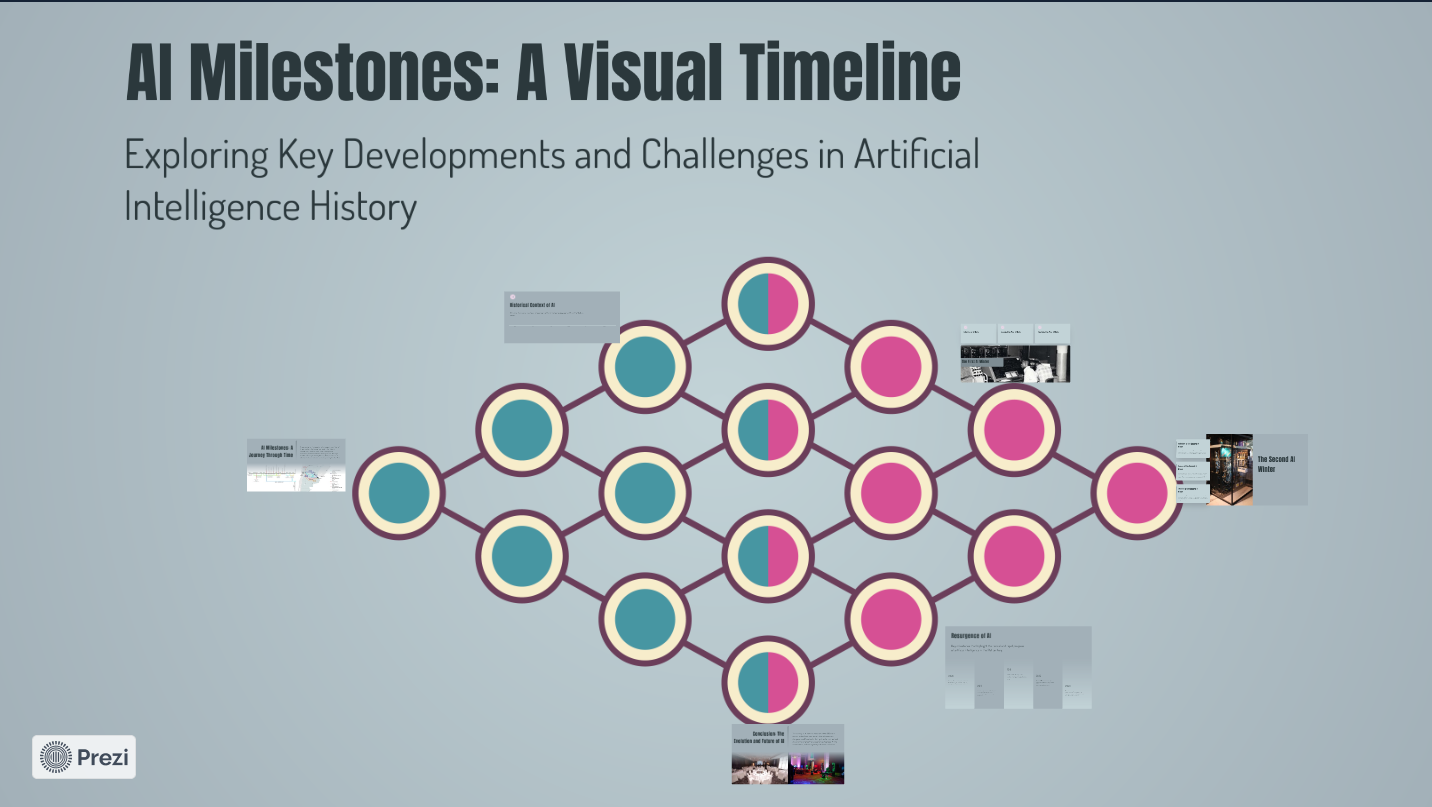
This artifact showcases my ability to communicate complex AI and Machine Learning concepts through clear visual storytelling. The presentation was designed using Prezi, focusing on how AI and ML are shaping modern industries, influencing daily life, and creating new opportunities for innovation.
Purpose
The goal was to explain AI/ML fundamentals in an engaging, non-technical way that helps audiences understand both the technology and its real-world impact. This artifact highlights my skill in simplifying complex topics for different audiences.
Tools and Technologies
- Prezi – for dynamic, interactive presentation design
- AI/ML content research – curated from class discussions and readings
- Graphics and structure – designed to improve comprehension and engagement
Key Skills Demonstrated
- Visual communication of technical ideas
- Storytelling with data and examples
- Audience-focused presentation design
- Research and synthesis of AI/ML topics
View the Presentation
Reflection
Creating this Prezi helped me strengthen my communication and visualization skills—two critical areas for any AI/ML professional. It taught me how to translate complex algorithms and data-driven ideas into visuals and language that anyone can understand.
This project complements my earlier artifact (NutriFit AI) by showing a different strength: not building an AI model, but explaining it clearly and persuasively to others. It reflects my ability to connect technical understanding with storytelling and user engagement.
Artifact 3: Machine Learning Training Methods – Interactive Chatbot Session
Overview
This artifact captures my work from an activity designed around collaborating with a pre-trained AI chatbot to explore different machine learning training methods. Instead of a traditional lecture or worksheet, the assignment used an interactive dialogue format where the chatbot acted as both a guide and a learning partner.
The focus of the session was to deepen understanding of supervised, unsupervised, and reinforcement learning, optimization strategies, and how these techniques connect to real-world AI systems.
Purpose
The goal of this activity was to strengthen my ability to reason through ML concepts by discussing them conversationally. The exercise challenged me to explain ideas, answer scenario-based questions, and refine my thinking with the chatbot’s feedback.
This format mirrors the type of collaborative problem-solving common in modern AI workflows, where humans and AI tools work together to analyze problems and test solutions.
Tools and Technologies
- SchoolAI.com Spaces – interactive learning environment
- Pre-trained AI chatbot – guided questioning, feedback, and hints
- ML concepts – supervised/unsupervised learning, reinforcement learning, optimization
Key Skills Demonstrated
- Applying ML concepts to real-world scenarios
- Explaining technical ideas clearly in a conversational format
- Using AI as a collaborative tool for reasoning
- Critical thinking and self-correction through guided dialogue
- Adapting learning pace and depth based on feedback from the AI assistant
What This Artifact Shows
This piece demonstrates a different strength compared to my earlier artifacts.
- Artifact 1 showed my ability to build and refine an AI-powered chatbot.
- Artifact 2 highlighted my communication and visualization skills.
- Artifact 3 focuses on my ability to think through ML problems, analyze training methods, and engage in interactive reasoning with AI tools.
Reflection
This activity pushed me to slow down and think more deliberately about how different ML training methods work and where they apply. The chatbot asked follow-up questions that made me justify my reasoning, catch mistakes, and strengthen my understanding.
What stood out most was how effective this format was for learning. The back-and-forth dialogue made the material feel practical instead of abstract, and the immediate feedback helped me correct misconceptions before they became habits.
This artifact represents my growth in using AI tools not just for building systems—but also for learning, analyzing problems, and improving my own understanding of machine learning.
Artifact 4: Reflection on Communication and Clarity in Team Collaboration
Overview
This artifact is based on a reflective assignment focused on the importance of clear communication in collaborative work. The reflection draws on two Biblical passages—1 Corinthians 14:8–9 and Genesis 11:6–7—to highlight how clarity, unity, and shared understanding are essential for effective teamwork.
Using these examples, I examined my own communication habits and identified areas for improvement, especially in technical or fast-paced project environments.
Purpose
The purpose of this reflection was to evaluate how my communication style affects team effectiveness. It pushed me to think about how unclear updates, missing context, or assumptions can disrupt progress. The assignment required connecting personal experiences, professional communication principles, and deeper insights from the passages studied.
Key Skills Demonstrated
- Critical self-assessment and personal development
- Ability to connect technical communication challenges with broader leadership principles
- Reflective writing grounded in real project experiences
- Understanding the link between clarity, teamwork, and project success
- Applying lessons learned to future professional practice
What This Artifact Shows
This artifact highlights a completely different strength than my previous portfolio pieces:
- Artifact 4 demonstrates self-reflection, communication awareness, and leadership maturity—skills that are crucial in any technical or AI-focused role.
Summary of the Reflection
In this assignment, I looked closely at how I communicate during team projects. I recognized a pattern: I tend to move fast, assume others understand my steps, and sometimes provide updates that are too technical or incomplete. This can create misalignment, just like the examples highlighted in the passages.
I also reflected on a time when unclear communication extended a project timeline because teammates misunderstood dependencies and began modifying code prematurely.
The reflection helped me identify several improvements:
- Make updates more structured and concise
- Check for understanding rather than assuming alignment
- Offer full context instead of partial instructions
- Tailor explanations to the audience
- Summarize decisions to ensure shared interpretation
Reflection
Completing this reflection helped me see how communication is not just about sharing information—it’s about ensuring others clearly understand the message. In technical fields, poor communication can slow progress just as much as technical issues.
This artifact represents my commitment to becoming a more intentional communicator who contributes to alignment, clarity, and collaboration in team settings.
Artifact 5: AI Ethics and Bias – Critical Analysis of the Amazon AI Recruiting Tool
Overview
This artifact is based on a critical thinking assignment focused on AI ethics, using the Amazon AI Recruiting Tool bias incident (2018) as a case study. Amazon developed an experimental AI system to automate résumé screening, but the model learned biased patterns from historical hiring data that favored male candidates. As a result, the system penalized résumés associated with women and failed to generalize fairly across applicants. Amazon ultimately discontinued the tool after identifying persistent gender bias.
This case highlights the ethical risks of deploying AI in high-stakes, human-centered decisions.
Purpose
The purpose of this artifact was to critically analyze ethical challenges in AI systems and move beyond surface-level technical explanations. The assignment required identifying key ethical issues, reflecting on assumptions, and proposing responsible solutions grounded in fairness, transparency, and accountability.
Key Ethical Issues Analyzed
1. Training Data Bias
The primary failure of the system stemmed from biased historical hiring data. What initially appeared to be a dataset issue revealed deeper, systemic inequality embedded in past human decisions. This demonstrated how AI can inherit and amplify existing discrimination when trained on unbalanced data.
2. Lack of Transparency in Decision-Making
The recruiting team could not clearly interpret how the model evaluated résumé features. This lack of explainability made it difficult to detect harmful behavior early and raised concerns about accountability when AI systems influence life-changing decisions such as employment.
3. Overreliance on Automation in High-Stakes Decisions
The attempt to fully automate résumé screening showed the risk of treating AI outputs as authoritative. Overreliance on algorithmic decisions can reduce human judgment, empathy, and critical oversight in sensitive domains.
Proposed Solutions
- Use balanced and representative training datasets with regular bias audits
- Apply fairness-aware and explainable AI techniques
- Require ethical review before deploying AI systems in hiring
- Maintain human-in-the-loop decision-making rather than full automation
- Clearly document model behavior, limitations, and evaluation results
Key Skills Demonstrated
- Ethical reasoning in AI and ML systems
- Critical analysis of real-world AI failures
- Ability to question assumptions behind algorithmic objectivity
- Understanding of fairness, transparency, and accountability
- Reflective thinking informed by both technical and societal perspectives
What This Artifact Shows
This artifact demonstrates my ability to evaluate AI systems not only on performance, but on ethical impact. It complements my earlier technical projects by showing that I understand the broader responsibilities involved in deploying AI in real-world contexts.
Reflection
This assignment shifted my perspective on AI ethics from viewing biased outcomes as technical mistakes to recognizing them as reflections of deeper societal issues. I initially assumed that replacing human decision-making with AI would lead to more objective results. Through this analysis, I realized that AI can actually magnify bias unless data, design, and oversight are handled carefully.
Going forward, this experience will influence me to approach AI development with stronger ethical awareness, critical evaluation of data sources, and an emphasis on human accountability in sensitive applications. This artifact represents my growth in thinking about AI not just as a tool, but as a responsibility.
About This Portfolio
This portfolio highlights my ongoing journey in AI and Machine Learning, showcasing key projects and reflections from my coursework and professional experiences. Each artifact reflects specific skills and milestones in applying AI tools to solve real-world problems.